

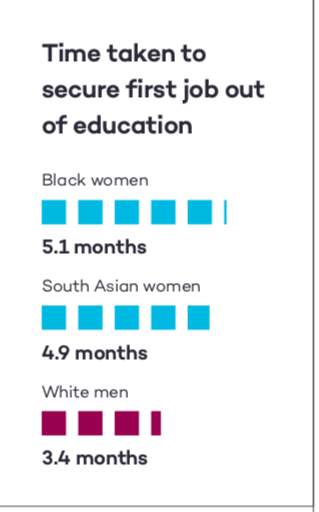
Research, conducted by hiring platform Total Jobs and The Diversity Trust, found that on average Black women waited 5.1 months to secure their first role after leaving full-time education and South Asian women, 4.9 months. This compared to white women who typically waited 2.8 months and white men 3.4 months.
The study, Uplifting Black and South Asian women in the workplace, shared findings based on a survey of 1,006 UK women of Black and South Asian heritage between May 11 and 19. It also surveyed 2,000 UK workers, of whom 873 were white men and 884 were white women.
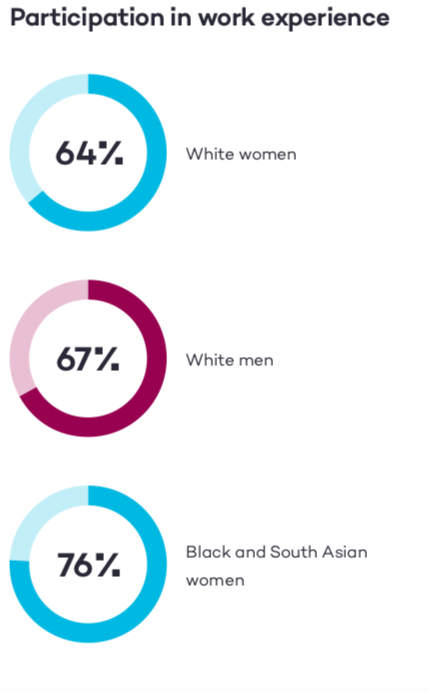
The survey also found that Black and South Asian women were more likely to have completed unpaid work experience or internships before landing their first job – 76% of them compared with 67% of white men and 64% of white women who had to do the same.
8% of Black and South Asian women said they adapted their name on résumés, to improve their chances of getting a job.
The findings also show that, while black and south Asian women had higher levels of confidence about their career trajectory than their white counterparts, this stagnated as their careers progressed.
The analysis also showed code switching – where a member of a minority group feels the need to change the way they speak or behave to fit into a company culture – and discrimination at work were taking their toll, with nearly two-thirds (62 per cent) of black and south Asian women reporting their wellbeing at work had suffered as a result.
Tinashe Verhaeghe, consultant at the Diversity Trust, said that despite the hardships, the women involved in the report had both confidence in themselves and a desire for employers to make the necessary changes to improve their chances to succeed in the workplace.
“There is sufficient evidence of the need for change, the impetus is now on employers and colleagues to act,” she said.
But, and it is a big but – is there anything this report uncovered that we didn’t already know as brown women in the workplace? I have been in HR for 20 years and seen various versions of this report over those two decades.
I am fed up of waiting for employers to take on the recommendations and implement change, and that’s why I stress it’s so important for our women to take control and understand what they need to do to progress in their professional lives.
Here are my tips to get ahead:
Stop being afraid of being yourself
Most people in the corporate world wear a mask. It’s just a fact. However, for women of colour at work, wearing a mask has many times been a necessity. According to studies by the Center for Women Policy, 21% of women of colour do not think they can be themselves at work. Another 28 to 44% believe they must downplay their ethnicity to increase their chances of success at work.
While this is still the reality in many, if not most, authenticity is still the best way to change the dialogue about women of colour at work. The more we hide behind our corporate masks, the less we can bring focus on the actual issues faced by women of color at work.
Get used to being uncomfortable
Many of us prefer the easy road. We possess a natural inclination to stick with the status quo, to resist the unknown, to stay comfortable. However, being uncomfortable is also an advantage. The more uncomfortable you are, the more prepared you tend to be. Getting used to uncomfortable and challenging environments is also the key to being innovative and a high performer.
Challenge yourself to speak up
Speaking up as a South Asian woman at work can be double-edged sword. On one hand, you may be labeled as “too assertive”. On the other hand, not raising your voice may make you seem incompetent or disinterested.
Whatever bias you may have to confront, I’ve found that the best answer, more often than not, is to speak up. You have way too much knowledge, insight and experience not to share it to empower others and increase your team and company’s efficiency.
Enlist allies
It’s rare that we have total discretion over our workload and responsibilities, so you’ll need to enlist allies — especially your manager — to help you achieve your vision. Assuming you have a good relationship, you can go to them and explain the career path you’d ultimately like to take. “I’m committed to doing a great job in this role,” you could say, “and I’d also like to position myself for success in the future. If you’re willing, I’d love your help in strategising around how to make that work.”
Manage your brand
One of the biggest challenges when it comes to career advancement is having to reinvent your brand. It’s not (in most cases) that you’re perceived negatively. It’s simply that people can’t imagine you in a more senior role, or in a new context, because they’re used to thinking of you in a certain way and fail to question those assumptions. That’s why it’s essential – even as you’re still performing your current role — for you to start shifting the narrative.
Just as the classic advice is to “dress for the job you want,” you should also raise your level of conversation, as though you’re already in your desired position. If you want to be promoted, start asking higher-level strategic questions in team meetings. If you’re planning to shift functional areas, read up on your new domain and begin posting about it on social media, or mentioning it in conversations with colleagues.
Get a supportive network
Surround yourself with women who understand the same challenges and you can lean on. Women’s networks are crucial for equality. They provide close connections to other women who might encounter similar struggles while still creating a diverse enough environment for personal and professional growth. Look into our Inspire Club for inspiration and motivation.
Whilst we wait for the power structures and privilege at play to be adapted and challenged further we can’t just sit back and resign ourselves to do nothing! We have to take action that is within our control and position ourselves to have the best possible chance. There is a lot we can do and I hope this has helped to understand that.
PS. We have several members who have approached their employer to reimburse their Inspire Club fees with the aid of this guide and case studies. Be brave enough to have that conversation with your employer too!