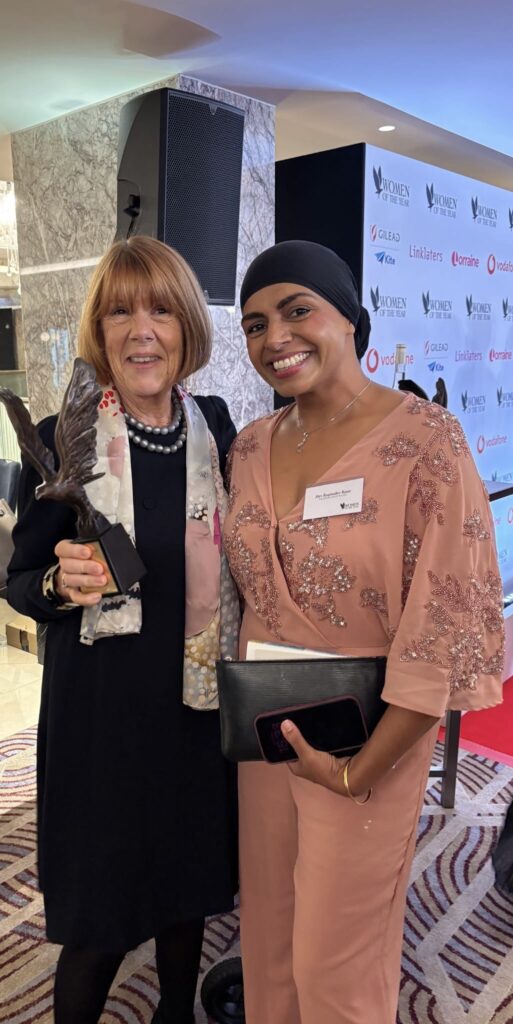
This week, I had the privilege of meeting Gisèle Pelicot.
There are people whose words stay with you long before you find yourself standing beside them. For me, Gisèle is one of those people.
“Shame must change sides.”
Four words that ask us to question who we blame, whose reputation we protect and what we expect women to carry.
As a South Asian woman, a mother and the founder of Asian Women Mean Business, I hear those words and think about the conversations we still need to have. In our homes. In our communities. With our daughters and our sons.
What does “shame must change sides” mean?
Gisèle Pelicot became known around the world after choosing to waive her anonymity during the trial concerning the sexual violence committed against her, orchestrated by her husband.
She allowed the proceedings to be public, bringing international attention to abuse that others might have expected her to hide.
Her message was clear: the shame belongs to those who commit sexual violence. A survivor has nothing to be ashamed of.
That should be something we all understand. Yet women are still asked questions that shift attention towards their behaviour.
Why did she trust him? Why didn’t she know? Why didn’t she leave? Why didn’t she speak sooner?
Each question can place another burden on someone already living with the consequences of another person’s actions.
Gisèle’s words challenge us to put responsibility where it belongs.
When women are made responsible for a family’s reputation
Growing up as a South Asian woman, I became familiar with a question many of us will recognise:
“What will people say?”
It can follow us through decisions about our relationships, our careers, our clothes and the lives we want to lead.
But when that question enters a conversation about abuse, it can have devastating consequences.
“Think of your children.”
“Don’t bring shame on the family.”
“Can’t you keep this private?”
Those words can leave a woman feeling responsible for the damage caused by speaking, while the person who harmed her avoids responsibility for what they did.
These pressures exist across cultures and communities. I am reflecting on my own because it is where I have a voice and a responsibility to ask difficult questions.
Whose peace are we preserving when we ask a woman to stay silent?
And what does protecting a family actually mean if someone within it is being harmed?
Speaking out must remain a survivor’s choice
I admire Gisèle’s courage. I also believe we need to be careful about what we ask of other survivors.
Nobody should have to make their trauma public to be believed.
Nobody owes us a police report, a court appearance, an interview or an explanation of why they have chosen privacy.
Gisèle made her own decision about being publicly identified. Other survivors deserve that same freedom to decide what is right for them.
Our support should never depend on how confidently someone speaks, how much they disclose or whether their response looks like the one we expected.
Helping women use their voices means being willing to listen
Through Asian Women Mean Business, I spend much of my working life encouraging women to become more visible, advocate for themselves and recognise the value of their voices.
Meeting Gisèle reminded me that encouraging someone to speak brings a responsibility to listen.
What happens after a woman tells us something difficult?
Do we listen without immediately questioning her choices? Do we respect her privacy? Do we offer practical support? Do we stay beside her when the conversation becomes uncomfortable?
We cannot expect women to feel safe speaking if our first response is to worry about the consequences for everyone else.
Change begins in those everyday moments, when somebody trusts us enough to tell us the truth.
What I want my daughter and son to understand
As a mother, I want my daughter to know that someone else’s abuse could never diminish her worth.
I want her to know she could come to me without fear of judgement. That I would listen. That protecting her would always matter more than what anybody else thought.
I want my son to grow up understanding respect, consent and responsibility, too.
These conversations belong in the way we raise all our children. Girls should not grow up believing that keeping themselves safe is entirely their responsibility, while boys miss the conversations about their own behaviour and the behaviour they accept from others.
The shame was never hers to carry
Meeting Gisèle Pelicot has stayed with me because her words reach far beyond a courtroom.
They ask something of all of us.
To question the language we use. To stop treating silence as a way of protecting people. To recognise that a family’s reputation can never be more important than someone’s safety.
And to make sure that when someone speaks about abuse, they are met with care rather than shame.
“Shame must change sides.”
It should never have been hers to carry.